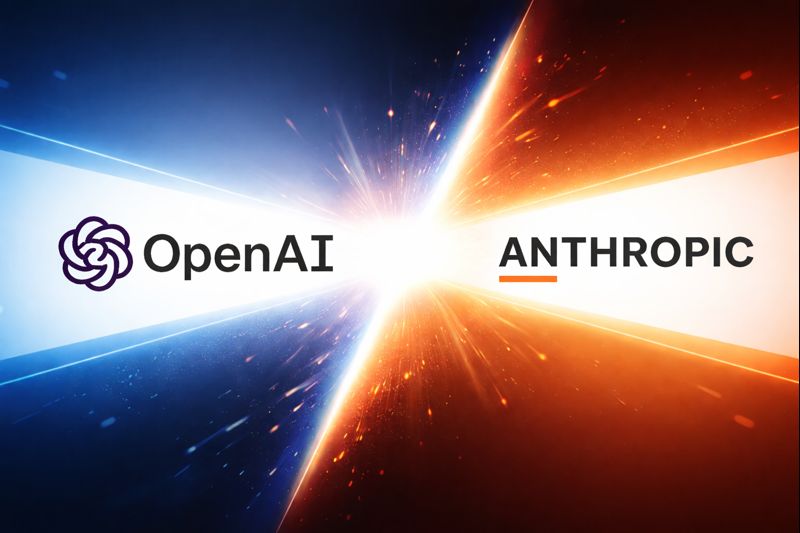
Two San Francisco-based AI rivals — Anthropic and OpenAI, the makers of the widely used large language models Claude and ChatGPT, respectively — both announced major pushes into healthcare in the days leading up to this year’s J.P. Morgan Healthcare Conference.
Last Wednesday, OpenAI unveiled ChatGPT Health, a dedicated health experience within ChatGPT that combines a user’s personal health information with the company’s AI with the promise of helping people better manage their health and wellness. The next day, the company launched OpenAI for Healthcare, which is a suite of AI tools designed to help healthcare providers reduce administrative burnout and improve care.
On Sunday, Anthropic made a healthcare splash of its own by announcing a new suite of Claude tools. The company is releasing new agent capabilities for tasks like prior authorization, healthcare billing and clinical trial workflows, as well as letting users connect and query their personal medical records to get summaries, explanations and guidance for doctor visits.
Both companies are staking their claim in healthcare AI, but each is charting a slightly different path.
Product scope and positioning
In October, Anthropic rolled out Claude for Life Sciences, which serves as a chatbot-style research partner for biotech teams. This week’s announcement, Claude for Healthcare, builds on this initial foray into healthcare by expanding Claude’s capabilities to support hospitals, payers and patients.
OpenAI’s ChatGPT Health is a consumer-oriented experience inside ChatGPT that connects to personal medical records and wellness apps. The company separately launched OpenAI for Healthcare, which is focused on servicing clinicians, healthcare administrators and medical researchers.
OpenAI’s enterprise and consumer elements are related but distinct products with different access paths, whereas Anthropic is blending industry and consumer tools within a single platform.
Use cases
Both Anthropic and OpenAI released tools to help the everyday consumer better understand their personal health journey. As for tools designed specifically with healthcare organizations in mind, Claude can assist with administrative and operational tasks such as prior authorization, billing, coding, claims validation, provider verification and CMS policy lookups. The platform also supports life sciences and clinical trial workflows, such as protocol drafting, data monitoring and recruitment.
OpenAI said its healthcare tools are designed to help clinicians and healthcare administrators with tasks like documentation, prior authorization, clinical reasoning, evidence synthesization and day-to-day operational workflows.
Access and customers
ChatGPT Health is not immediately available to everyone — OpenAI is rolling out access via a waitlist for users. For the OpenAI for Healthcare offering, early health system partners have begun to pilot the platform, including Cedars-Sinai, HCA Healthcare, Baylor Scott & White Health and Boston Children’s Hospital.
Anthropic’s Pro and Max subscribers can already connect their medical records and query them in Claude. Healthcare organization customers include Banner Health, Sanofi, Novo Nordisk, Heidi Health, Elation Health and Viz.ai.
Personal health data integration
Anthropic has direct data integrations with HealthEx and Function Health — and it said that Apple Health and Android Health Connect integrations are coming soon. The startup specified that personal data is not used for model training and users can revoke access.
ChatGPT Health lets users connect their medical records and wellness apps, such as Apple Health and MyFitnessPal, and OpenAI also emphasized privacy and the separation of health data from other ChatGPT memory and training.
Photo: ChatGPT