Liquid Collagen vs. Collagen Powder: Which Absorbs Better?
The liquid vs. powder collagen debate shows up in my DMs constantly — and both sides have legitimate arguments. My honest take is that for most healthy women, the difference in outcomes between the two formats is less significant than the marketing suggests. What matters far more is whether the collagen is properly hydrolyzed, whether you are getting an adequate daily dose, and whether you are taking it consistently. But there are real distinctions worth understanding.
I developed my Harmony Liquid Gold collagen specifically for patients who want the ready-to-drink experience — no measuring, no mixing, no powder residue. But I also recommend my unflavored collagen peptides powder daily. Let me give you the honest comparison.
The Variable That Actually Matters Most — Hydrolysis
The critical determinant of collagen absorption is not whether the product is liquid or powder — it is whether the collagen has been hydrolyzed (enzymatically broken down into peptide fragments small enough to cross the intestinal wall). Hydrolyzed collagen peptides absorb efficiently in either liquid or powder form because the physical format has already been addressed at the molecular level. A liquid product with raw, unhydrolyzed collagen will absorb worse than a powder with properly hydrolyzed peptides.
Where Liquid Has a Genuine Advantage
-
No dissolution step required — liquid bypasses the need for stomach acid to break down a powder or capsule matrix
-
Faster transit through the stomach — liquids move more quickly to the small intestine where absorption occurs
-
Cofactor pairing — many quality liquid collagen products include vitamin C in the same serving, supporting collagen synthesis
-
Better compliance for people who resist the mixing routine — if you will take it every day, the format is right for you
Where Powder Maintains a Genuine Advantage
-
More protein per serving — quality powders like my collagen peptides unflavored deliver 10–18g per serving vs. 2–5g in a typical liquid shot
-
More economical per gram of collagen — powder consistently offers better value for the same collagen dose
-
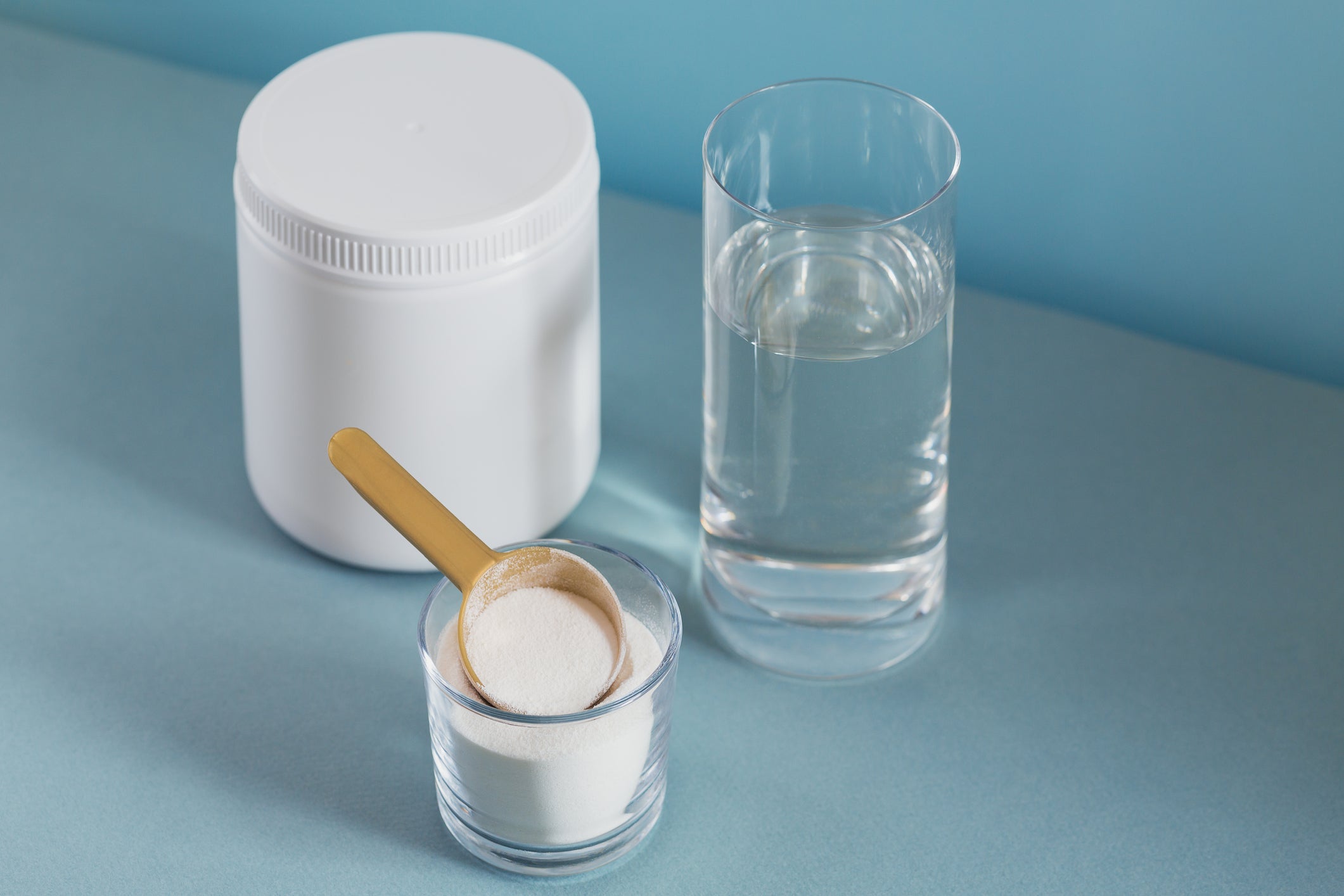
More versatile — integrates into coffee, smoothies, soups, oatmeal without changing the experience significantly
-
Shelf-stable without refrigeration — most liquid collagen products require refrigeration after opening
What the Research Shows
The studies I summarize in my overview of the benefits of collagen use primarily powdered hydrolyzed collagen peptides — typically 2.5–15g daily for 8–12 weeks. The documented outcomes (skin elasticity improvements, joint comfort, gut lining support) are based on this format. This does not mean liquid is ineffective — it means we have more research data on the powder format. Properly formulated liquid collagen producing equivalent doses should produce equivalent outcomes.
The Practical Answer
Use the format you will actually use every single day without fail. If liquid collagen means you take it consistently because you love the ritual and the taste, liquid is the superior choice for you. If powder integrates more seamlessly into your morning coffee or smoothie, use powder. Consistency over 8–12 weeks at an adequate dose is what produces results. The form of delivery is secondary to those two variables.
My recommendation for most patients: use my unflavored collagen peptides powder as the primary daily format (for its higher protein-per-serving) and Harmony Liquid Gold on the days when liquid format is more convenient or appealing. Together, they ensure both format flexibility and optimal daily dosing toward the targets my how much collagen per day guide recommends.
Optimizing Your Daily Collagen Dose Across Formats
Most of my patients are getting collagen from more than one source once they understand how the formats work — and that multi-source approach is exactly right. Here is how I think about building a daily collagen total across formats: bone broth as the foundation (15–16g of collagen protein per serving), Harmony Liquid Gold as the supplemental liquid experience (typically 5–10g per serving), and unflavored collagen peptides as a versatile add-in to coffee, smoothies, or oatmeal (10–18g per scoop). The goal is reaching 10–20g of hydrolyzed collagen daily across all sources.
Liquid collagen products like my Harmony Liquid Gold serve a specific role in this system: they are the format for patients who want the collagen experience to feel like a treat rather than a supplement. The ready-to-drink format, the flavor, the ritual of a daily beauty shot — these are real psychological benefits that contribute to consistency. And consistency is ultimately the variable that determines results. A slightly lower-dose liquid product taken every single day outperforms a higher-dose powder taken three times a week.
Who Should Prioritize Liquid Over Powder
Liquid collagen is particularly well-suited for a few specific patient profiles: women who struggle to mix or dissolve powders in their preferred beverages, patients with digestive conditions that may make efficient protein absorption from powder matrices harder, and anyone for whom the daily ritual and enjoyment of a ready-to-drink product is what makes the habit sustainable long-term. For these patients, the slightly lower protein-per-serving of liquid is more than offset by the dramatic improvement in daily consistency.
Powder is better suited for patients who are actively tracking collagen intake, want maximum protein per serving for therapeutic dosing goals, prefer to add collagen to existing food and beverage preparations, and are not troubled by the mixing step. Both are valid. Both work. Choose the format that fits the life you actually live, not the life you aspire to live.
A Note on Collagen Types and Their Relevance
You will see references to Type I, Type II, and Type III collagen on product labels, and it is worth understanding what these distinctions mean for your specific goals. Type I collagen is the most abundant in the body and is found in skin, tendons, bone, and gut. It is the primary type relevant to skin elasticity and most of the joint research. Type II collagen is concentrated specifically in cartilage and is most relevant to joint health in people with significant cartilage concerns. Type III collagen is found alongside Type I in skin, blood vessels, and internal organs.
For the goals most common in my patient population — skin health, joint comfort, and gut lining support — Type I and Type III collagen (both bovine) cover the most ground. My Harmony Liquid Gold and Collagen Peptides Unflavored both use grass-fed bovine collagen providing Types I and III. For patients with specific joint cartilage concerns, a formula that adds Type II collagen through chicken sternum cartilage may be worth exploring as a targeted addition.
Frequently Asked Questions
|
Frequently Asked Question |
Answer |
|
Is liquid collagen more effective than powder? |
Both deliver the same collagen peptides once absorbed. Liquid may absorb marginally faster as no dissolution step is required — a potential advantage for people with reduced stomach acid. Powder typically delivers more collagen protein per serving and is more cost-efficient. The hydrolysis quality matters more than which format you choose. |
|
How much collagen should I take per day? |
Research showing skin, joint, and gut benefits uses doses ranging from 2.5–15g of hydrolyzed collagen daily. Most studies showing meaningful skin benefits use 5–10g daily. I recommend aiming for 10g or more from combined sources when possible. |
|
When should I take collagen for best results? |
Morning on an empty stomach allows for efficient absorption without competition from other proteins. Some research suggests taking collagen with vitamin C and before exercise may optimize delivery to joint tissue. The most important factor by far is consistent daily use. |
|
Does liquid collagen need to be refrigerated? |
It depends on the specific product. Many liquid collagen products require refrigeration once opened. Check your product’s packaging for guidance. Collagen powder is typically shelf-stable and does not require refrigeration. |