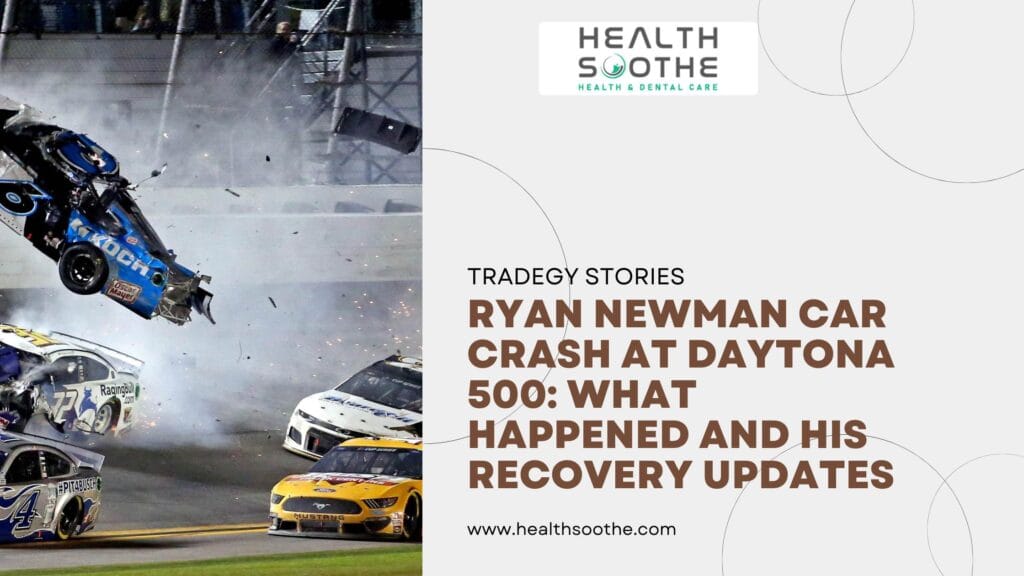
Ryan Newman’s crash on the final lap of the 2020 Daytona 500 was one of the most violent accidents in modern NASCAR history. His car flipped, caught fire, went airborne, and was struck mid-air by a second vehicle travelling at nearly 200mph. It took emergency crews 16 minutes to extract him from the wreckage.
He walked out of Halifax Medical Center two days later, hand-in-hand with his daughters.
What made that survival possible and what injuries does a crash like this typically cause to the face, jaw, and teeth is a story that goes far beyond the race itself.
Related accident:
What Happened at the 2020 Daytona 500
During the final lap, Ryan Blaney’s car nudged Newman’s No. 6 Ford from behind, sending it into the retaining wall at high speed. The impact launched Newman’s car airborne, where Corey LaJoie’s vehicle struck it directly on the driver’s side. Newman’s car landed on its roof, slid across the finish line engulfed in flames, and came to rest on the track.
Emergency crews extinguished the fire, righted the vehicle, and spent 16 minutes carefully extracting Newman to avoid worsening spinal or head injuries. He was transported immediately to Halifax Medical Center in Daytona Beach in serious condition.
By Tuesday and less than 48 hours later he was awake, talking with family, and engaging with his medical team. By Wednesday, he was photographed walking out of the hospital with his daughters.
What Medical Injuries Are Common in High-Speed Racing Crashes
A crash at 200mph subjects the human body to forces far beyond what everyday accidents produce. Newman’s survival and the nature of his undisclosed injuries reflects both the violence of the impact and the effectiveness of modern racing safety systems.
Medical professionals treating high-speed crash victims commonly assess for:
- Traumatic Brain Injury (TBI): The most serious concern in any high-speed crash. The brain can sustain concussive or contusive damage even when the skull is intact, caused by the brain moving violently inside the skull during rapid deceleration. Symptoms range from brief disorientation to prolonged unconsciousness, memory loss, and neurological changes. Newman being described as “awake and communicating” within 48 hours was a strongly positive neurological sign.
- Cervical Spine Injury: Whiplash and spinal compression are common in rollover crashes. Emergency crews are trained to stabilise the neck and spine before extraction which is a primary reason Newman’s extraction took 16 minutes rather than seconds.
- Chest and Rib Trauma: The HANS device (Head and Neck Support) and harness system protect drivers from the worst chest injuries, but high-impact crashes can still cause rib fractures and internal bleeding from the compressive force of the seatbelt during rapid deceleration.
- Facial and Orbital Fractures: Flying debris, airbag deployment, and direct impact with the steering column or roll cage can cause fractures to the orbital bones around the eyes, the cheekbones, and the nasal bones all of which require specialised maxillofacial surgical intervention.
The Dental and Oral Injuries Nobody Talks About in Racing Crashes
High-speed crash trauma frequently involves significant dental and oral injuries yet these are rarely discussed in race coverage because they are considered secondary to life-threatening injuries. In reality, dental trauma from crashes can cause lasting complications if not treated promptly.
Tooth avulsion and fracture:
Violent impact can knock teeth out entirely (avulsion) or fracture them at the root or crown. Avulsed teeth can sometimes be reimplanted if treated within 30–60 minutes — time that is often lost during emergency crash response. Fractured teeth that expose the dental pulp require immediate root canal treatment to prevent infection.
Jaw fractures (mandibular and maxillary):
The mandible (lower jaw) is one of the most commonly fractured bones in facial trauma. A fractured jaw from crash impact requires surgical fixation and can take 6–12 weeks to heal, during which eating, speaking, and oral hygiene are significantly affected. Maxillary (upper jaw) fractures are less common but more complex to treat.
TMJ trauma:
The temporomandibular joint hinge connecting the jaw to the skull is highly vulnerable in crash scenarios. TMJ injury from high-impact trauma can cause chronic jaw pain, clicking, locking, and difficulty opening the mouth wide, sometimes persisting for years after the initial injury.
Soft tissue lacerations:
Cuts and tears to the lips, tongue, gums, and inner cheek are common in crash trauma. Deep lacerations to the tongue or floor of the mouth can cause significant bleeding and require immediate suturing. Gum lacerations that expose bone require treatment to prevent bone infection (osteomyelitis).
Tooth intrusion:
Impact can drive teeth upward into the jawbone rather than knocking them outward. Intruded teeth require orthodontic or surgical repositioning and long-term monitoring for root resorption.
How NASCAR Safety Technology Reduces These Injuries
The survival of drivers like Ryan Newman — and the dramatic reduction in NASCAR fatalities since Dale Earnhardt’s death in 2001 — is directly attributable to safety innovations that specifically protect the head, face, and neck:
- The HANS Device: The Head and Neck Support device connects the helmet to the shoulder harness, preventing the violent forward whipping motion of the head during impact that caused the fatal basilar skull fractures seen in earlier NASCAR deaths. The HANS device has been credited with preventing numerous fatalities since its mandatory introduction in 2001.
- SAFER Barriers: The Steel and Foam Energy Reduction (SAFER) barrier lining NASCAR tracks absorbs impact energy rather than reflecting it back into the car. This directly reduces the deceleration forces that cause facial, dental, and cranial injuries.
- Improved helmet design: Modern NASCAR helmets use multi-layer composite construction with energy-absorbing foam liners specifically engineered to reduce rotational brain injury — the mechanism behind many concussions and TBIs in high-speed crashes.
- Fire-resistant equipment: Newman’s car caught fire immediately after impact. Fire-resistant suits, gloves, and balaclava liners protect drivers from facial burns and inhalation injuries during the critical minutes before emergency crews can respond.
Ryan Newman’s Recovery: What It Tells Us About Trauma Care
Newman’s remarkably fast recovery walking out of hospital within 48 days reflects both the quality of trauma care at Halifax Medical Center and the effectiveness of the safety systems that limited the severity of his injuries despite the violence of the crash.
The fact that his specific injuries were never publicly disclosed is standard practice in sports medicine. Roush Fenway Racing confirmed only that he was in serious but not life-threatening condition. Language used by trauma teams to indicate no immediate threat to major organ systems.
His being awake and communicative within 48 hours ruled out the most severe forms of traumatic brain injury. His ability to walk unassisted within days suggested no significant spinal cord involvement. The speed of his discharge indicated that any injuries sustained were stable, manageable, and responding well to treatment.
Newman returned to NASCAR competition that same season a testament to both his physical resilience and the quality of his medical care.
What to Do If You or Someone You Know Has Dental Trauma After an Accident
If a crash or physical trauma causes dental injury, the following steps can significantly improve outcomes:
- For an avulsed (knocked-out) tooth: Pick it up by the crown, not the root. Rinse gently with milk or saline — not water. Place it back in the socket if possible, or store it in milk and get to a dentist within 30 minutes.
- For a fractured tooth: Cover sharp edges with dental wax if available and see a dentist immediately. Exposed pulp is a dental emergency.
- For jaw pain or inability to open the mouth after an accident: Go to an emergency department immediately. It might be a jaw fracture that need a dental x-ray.
- For soft tissue lacerations: Apply firm, clean pressure to control bleeding. Deep lacerations to the tongue or floor of the mouth require emergency suturing.
- For suspected TMJ injury: Avoid hard foods, apply warm compresses, and see a dentist or oral surgeon. Do not ignore jaw pain after head trauma.