September 09, 2026
mbg Senior Commerce Editor
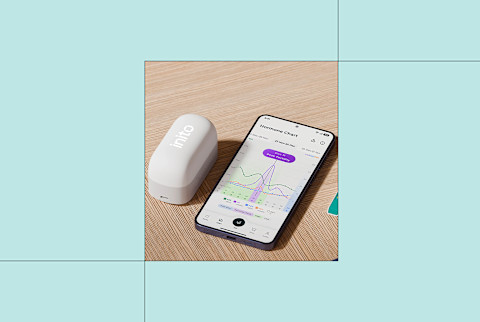
Image by Inito / mbg creative
September 09, 2026
Ovulation strips ask you to make a lot of decisions with very little information. Is that line darker than yesterday’s? Does that count as positive? And the one no strip can answer: Did I actually ovulate this month, or did my body just think about it?
Because it tracks your actual hormone values rather than population averages, it provides personalized insights to help you identify your six-day fertile window and confirm whether you actually ovulated, instead of simply predicting it.
Eager to understand the accuracy of Inito—and what experts like OB/GYNs and reproductive endocrinologists really think about the science-backed fertility monitor—I dove headfirst into learning more about the brand.
Along with chatting with experts, I tested the monitor firsthand to see what it’s really like to track your hormones. As someone not yet actively trying to conceive, I also wanted to understand the benefits of Inito for someone who is dealing with PCOS (now called PMOS), irregular cycles, or pregnancy loss.
Below, learn how the Inito Fertility Monitor works, where doctors think it helps (and where it doesn’t), what the science actually supports, and my final verdict on whether Inito is worth it.
Inito Fertility Monitor
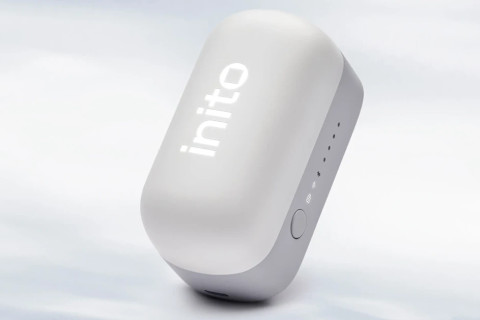
What is the Inito Fertility Monitor?
The Inito Fertility Monitor provides lab-grade hormone readings at home, helping people who are trying to conceive understand their hormone trends. This includes people with PCOS (now called PMOS), people who are 35 or older, or even people who are recently off hormonal birth control.
- Estrogen (E3G) rises as a follicle matures, which signals your fertile window is opening
- LH surges about 24 to 36 hours before ovulation
- FSH stimulates follicle growth early in your cycle and adds context to the overall pattern
- PdG, a urine metabolite of progesterone, rises after ovulation. This is what lets Inito confirm ovulation happened instead of just predicting it.
Together, these four hormones give a much fuller picture of your cycle than any one hormone can, which, in the most basic sense, is how Inito differs from standard ovulation tests.
This in-depth reading allows the Inito Fertility Monitor to map your full six-day fertile window and confirm whether you actually ovulated.
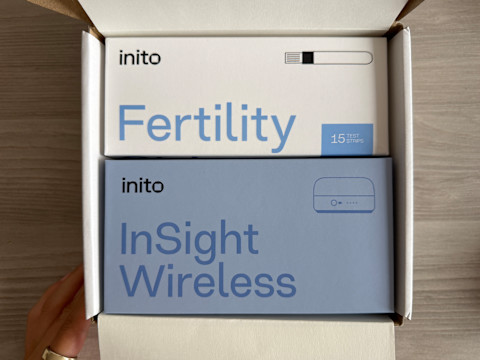
Image by Carleigh Ferrante / mbg creative
Is Inito better than OPKs, BBT & cervical mucus tracking?
“Most traditional tools look at one piece of the puzzle,” explains integrative fertility expert Cyntia Onuoha-Brown, PharmD. “OPKs only measure LH. BBT confirms ovulation after the fact. Calendar apps predict based on averages.”
However, Inito is focused on giving users a full picture of the cycle. “We can see estrogen rise, LH surge, and then PdG confirmation,” Onuoha-Brown adds. Here’s why focusing on multiple hormones matters for cycle tracking:
Inito vs OPKs
The most glaring difference between Inito and OPKs is that OPKs measure LH and nothing else. While that can work fine for some people, an LH surge is a prediction rather than a guarantee.
“LH tells you that ovulation is likely to happen soon,” says Lora Shahine, M.D., a double board-certified OB/GYN and reproductive endocrinologist. “An LH surge doesn’t always guarantee ovulation.”
What’s more, LH can fluctuate. Only about 42% of women get the single sharp surge that OPKs are designed around. Everyone else gets multiple peaks or a smaller rise, which a threshold-based test can easily misread.
PdG can actually tell you whether ovulation occurs, per Dr. Shahine. This is what allows Inito to confirm you’ve ovulated at home without requiring a blood draw.
So if you’re wondering whether Inito confirms ovulation or just predicts it, that’s the short answer: It does both.
Inito vs. Cycle Apps
Cycle apps have a limitation: They predict from averages, which may look nothing like your own cycle. After all, there’s no universal “correct” hormone level. Rather, each person has to look at hormone shifts relative to their own baseline, so a single hormone reading rarely reveals much.
What’s more, there’s also a lot of variation within cycles. Nearly 7 in 10 women see cycle variation of up to six days, and almost half see swings of seven days or more.
Unlike cycle tracking apps, Inito’s hormone tracking is powered by insights from more than 40 million hormone data points. This helps deliver fertility insights personalized to your hormone levels and identify your fertile window, even when your hormone patterns don’t follow a textbook cycle.
Inito vs. BBT
Basal body temperature (BBT) predicts ovulation based on a slight drop in temperature followed by an increase post-ovulation. Temperature must be taken at the same time every morning before getting out of bed and can fluctuate at the slightest change in routine, like a bad night’s sleep or a glass of wine.
Not only is BBT inconvenient, but the tracking method is most effective at predicting ovulation after it’s already happened—so there’s less time to prepare for a fertile window.
Inito fits into your life, not the other way around. Whether you’re traveling, working, or on vacation, you can test with the same ease, no need to stay close to the device or follow the same routine every day. The only constant is testing every time the app suggests.
With the Inito Fertility Monitor, you’re reading actual hormone values and trend charts and getting clear information. Plus, you can easily share data with your doctor, which every physician I interviewed brought up as a huge bonus for Inito.
How Inito compares
| Category | Inito Fertility Monitor | OPKs | BBT (temping) | Cervical mucus |
|---|---|---|---|---|
| Hormones measured | 4 (E3G, LH, FSH, PdG) | 1 (LH) | None | None |
| Predicts fertile window | Yes, up to 6 fertile days | Partially (1–2 days around LH surge) | No, retrospective only | Roughly, and subjective |
| Confirms ovulation | Yes, via PdG rise | No | Indirectly, as a result of progesterone rise | No |
| Output | Hormone values + trend charts | Yes/no or line darkness | Daily temperature | Self-observation |
| Works with irregular cycles/PCOS | Tracks your hormone trends personalised to your individual baseline | Can mislead as it is based on population averages | Hard to interpret | Hard to interpret |
| Shareable with clinician | Yes | Limited | Manual logs | Manual logs |
What do fertility specialists actually look for when they evaluate hormone data?
Every specialist I interviewed said the same thing in different words: One number doesn’t mean much; it’s the pattern that you want to pay attention to.
“I rarely focus on one hormone or one isolated number. I’m looking for the overall pattern across the cycle,” Dr. Shahine says. She likes to see estrogen rising in the follicular phase, followed by an LH surge, leading into a sustained rise in PdG that confirms ovulation.
“Fertility is rarely determined by a single data point—it’s the overall hormonal sequence that provides the most useful information,” she adds.
Dr. Shahine looks closer where there is no clear evidence of ovulation across multiple cycles, repeated LH surges with no PdG rise afterward, cycles that stay unpredictable, and luteal phases that come up consistently shorter than 11 days.
“None of these findings are diagnoses by themselves, but an Inito chart can be an excellent starting point for that conversation,” she explains.
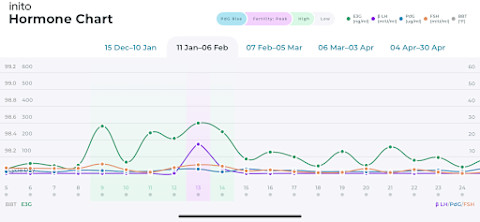
Example of no PdG rise
Image by Inito / mbg creative
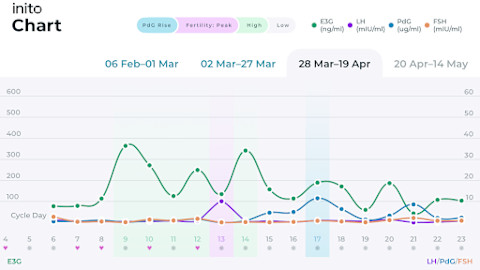
Example of short Luteal phase
Image by Inito / mbg creative
This is why fertility specialists can benefit from patients bringing hormone data to their appointments.
“The patients who come in with hormone data have fundamentally different appointments than those who come in with just a positive OPK and a date,” says Sasha Hakman, M.D., a double board-certified OB/GYN and reproductive endocrinology and infertility specialist. “They know their cycle. They can tell me when something felt off. That kind of informed patient leads to faster, more precise clinical decisions and better outcomes.”
Susan Nasab, M.D., a reproductive endocrinologist, says the full-cycle view is “particularly important in cases of PCOS, ovulatory dysfunction, premature ovarian insufficiency, and early perimenopause. Having this detailed hormonal history allows us as REI physicians to make more informed decisions and personalize treatment more effectively.”
If you have PCOS and you’ve wondered whether an LH-based test can even work for you, Dr. Shahine addressed that directly: “Many people with PCOS have an elevated LH:FSH ratio, which is one reason single-threshold ovulation predictor kits can misfire.”
Looking at the whole sequence instead—does estrogen rise before the LH surge, is there a real LH peak, does PdG rise after—”often gives a much clearer picture than relying on LH alone.”
Is Inito accurate? The science behind its hormone tracking
Going into my Inito deep dive, this is the question I cared about most. It all sounded great in theory, but I wanted to find out more about how it all actually works, how accurate, reliable, and precise the Inito Fertility Monitor is.
How Inito measures hormones
Inito uses Spectral Mapping technology. Think of Inito’s Spectral Mapping as a high-tech scanner for your fertility test strip. Instead of simply taking a picture of the strip and looking at how dark or light the lines appear, the reader analyzes the Inito strip in much more detail.
It uses both visual colorimetric imaging and fluorescence signals to detect and distinguish four different hormones—estrogen, LH, PdG, and FSH—then uses that information to provide actual hormone values. A traditional reader is like looking at a painting and saying, ‘I see blue.’ Spectral Mapping technology is like scanning the entire painting in high resolution, capturing 100× richer information to distinguish subtle signals that simpler readers can miss.
Plus, the research supports its accuracy. One study looked at 73 data points across different phases of the cycle and found that Inito’s urinary hormone patterns tracked the corresponding serum hormone trends with 95% correlation, meaning the trends you see in the app closely mirror what a blood draw pattern would show. Separately, research published in Nature’s Scientific Reports found that Inito confirms ovulation with over 92.2% 1accuracy.
What makes Inito’s data precise
By collecting more information from the test strip and cross-checking those signals, Inito can better distinguish one hormone from another, even when they’re being measured on the same strip. This is because each individual track on the test strip ensures no cross-reactivity happens between hormones.
And Inito’s system captures more than 100 times the signal data of traditional readers, which helps its algorithms account for things like lighting, humidity, dust, and other bathroom variables that could affect a reading.
That consistency is the whole ballgame, because the value of hormone tracking is in being able to see the trend: whether your estrogen is climbing, whether that LH bump was the real surge, whether PdG stayed up long enough to confirm ovulation.
Dr. Shahine also pointed out something I hadn’t considered about blood work: “Progesterone secretion is naturally pulsatile,” she says. “A single blood test represents one moment in time, whereas serial PdG measurements allow you to look at the full picture over several days.”
That said, urinary hormone tracking shows patterns. It doesn’t replace a lab measurement when your doctor needs an exact serum value. Shahine puts it best, calling home PdG testing “a trend-based tool that complements, rather than replaces, medical evaluation.”
Why precision matters for real-world cycles
Hormone tracking works best when you look at patterns, not one isolated result. Most fertility decisions aren’t made off a single number—they’re made by watching hormones rise, peak, fall, and stay elevated over time, and by seeing how multiple hormones move together across the cycle.
That’s where precision comes in—and it’s different from accuracy. Accuracy tells you whether a single reading is close to the true value. Precision tells you whether repeated readings are consistent, test after test, so you can trust that a shift in the number reflects your hormones changing, not the test. Both matter, but for reading a trend across days, precision is what makes the pattern visible.
That consistency lets patterns emerge clearly, cycle after cycle—especially when you’re tracking more than one hormone rather than relying on a single signal. That too, in at-home conditions with varying light, dust, humidity levels, and not a controlled lab environment. It’s why Inito has built its measurement system around precision: in head-to-head lab testing, it delivered the most precise* fertility hormone values of any at-home test.
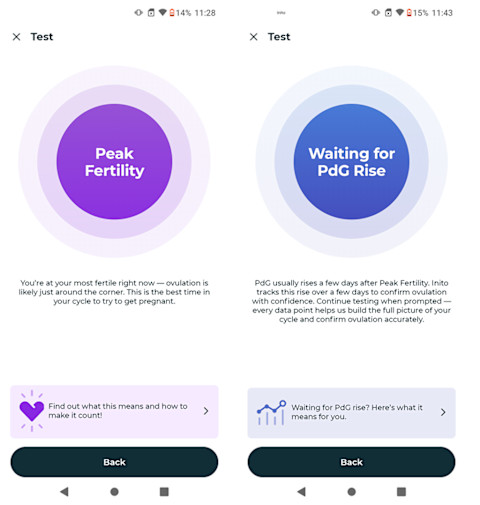
Image by Inito / mbg creative
What is it like using Inito during a real fertility journey?
When it comes to at-home testing and monitoring, one of my biggest frustrations in the past has been data that’s difficult to read, or a testing process that’s overwhelming or time-consuming.
That’s why I love how straightforward and easy to use the Inito Fertility Monitor is, and how specific and personalized the data gets. Inito reads your hormone trends in the context of your own cycle and turns them into a daily status: Low Fertility, High Fertility, Peak Fertility, or Ovulation Confirmed.
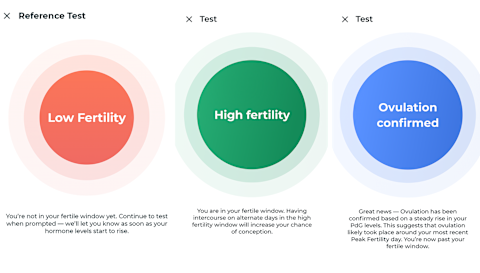
Image by Inito / mbg creative
Inito recommends beginning your testing on day six of your cycle, so I waited patiently for that day. In the meantime, I downloaded the app and synced up my device, which took less than five minutes.
On day six, I followed the instructions given in the app. As soon as I woke up, I peed in the provided cup (Inito recommends using first-morning urine), filled it to the marked line, unwrapped and dipped in a fresh strip for 15 seconds, placed the cap on the strip, inserted the strip into the Inito device, and waited for it to sync.
I love how the Inito app walks you through the entire process step by step, with handy videos and timers along the way. Once the Inito device syncs to your Wifi (which I had set up previously), the app starts a 10-minute timer. At that point, you can close the app and go about your morning while the device analyzes your results.
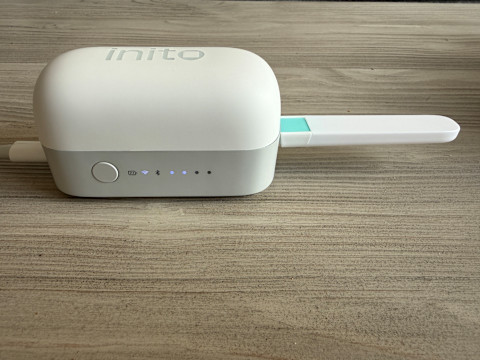
Image by Carleigh Ferrante / mbg creative
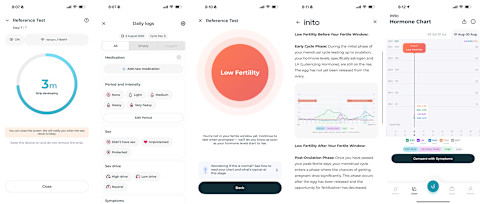
Once the results are ready, you’ll receive a notification on your phone prompting you to return to the app. The results show your fertile days as High Fertility and Peak Fertility. The days outside the fertile window are marked as Low Fertility.
I knew cycle day six wasn’t meant to be a fertile day, but seeing my result marked as Low Fertility did feel surprising at first. However, it’s completely normal, as you are only fertile for up to six days each cycle, and all the other days are considered Low Fertility. What I found helpful was that Inito provided a link to read more about what the results meant and what to expect throughout your cycle.
I loved being able to read a very clear breakdown with example charts explaining what a “typical” cycle might look like. Once you have test results, you can view your chart in the “chart” tab of the app, which maps out all four hormone levels on a single chart that updates daily as you test.
Overall, the testing experience has been extremely easy and very informative. I’ve now tested every morning from day six to day 13, and it’s been so interesting to see how my hormone levels change throughout my cycle! I also really enjoy being able to log symptoms to track how they align with my chart.
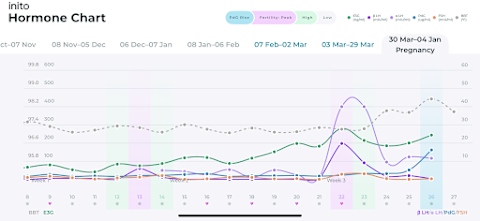
Image by Inito / mbg creative
Example of writer’s feedback from app.
Image by Carleigh Ferrante / mbg creative
What other users say
The user stories I read tracked closely with what the doctors described, especially for cycles that don’t cooperate.
The Second LH Surge That Almost Went Unnoticed: How Inito Helped Bailey Conceive
One Inito user, Bailey Blackburn, had regular periods but unpredictable ovulation timing, and Inito caught something a calendar never would have.
“I ended up having two LH spikes in April, and would have never known had I not been tracking with Inito,” she says. “The second LH surge was very late in the month, and I thought I had already ovulated… it caught my second LH surge, and that’s when we conceived.”
From Four Unsuccessful Cycles to a Successful Pregnancy: Brooke’s Inito Journey With Secondary Infertility
For user Brooke Gresock, what showed up was the absence of a pattern. She’d had four unsuccessful cycles trying for her second child. “After the first cycle using Inito, I found out I was not ovulating. I showed my Inito graph to my gynecologist; she tested me further and agreed to start me on medication. The very next medicated cycle, I tracked with Inito, confirmed ovulation, and was pregnant!”
A Decade of Unexplained Infertility: How Inito Helped Katie Get Pregnant
Katie McCormick spent 10 years trying to conceive—even visiting the OB—before testing out Inito. “Besides showing me that I ovulated at a later date than I actually thought, [Inito] encouraged me to speak with my OB about my PdG levels, which my OB later confirmed through bloodwork were low.” She said this was “vital information” for getting pregnant after years of defeat.
Living With PCOS (Now PMOS): Beth’s Journey With Inito
Beth Donati has PCOS (now PMOS) and Hashimoto’s, with cycles running anywhere from 60 to 90 days. She started calling Inito’s predictions “voodoo magic.”
As she put it: “I would often get alerts from Inito asking ‘Did you start your period today?’ and think ‘that’s crazy, it’s at least a week away’—only to start a few hours later.”
The thing these stories have in common isn’t the pregnancy at the end. It’s that following a pattern all month felt different from waiting to check a result on one specific day.
People described feeling more informed and less in the dark, and walking into appointments with something concrete to show their doctor. Nobody described it as a substitute for medical care.
Inito Fertility Monitor
Who is Inito best suited for?
Based on my research, the expert insights, and Inito’s user stories, the Inito Fertility Monitor makes the most sense for:
- People who need more than traditional tracking gives them. If OPKs, temping, or cycle apps have left you with more questions than answers, real hormone values fill in the blanks.
- People with complex or variable cycles. Will Inito work for irregular cycles? This is arguably where Inito excels as an option. It’s a trusted pick for people with PCOS, long or irregular cycles, coming off birth control, TTC after a loss, secondary infertility, or trying at 35+. These are the situations where single-threshold tests are most likely to steer you wrong.
- People who want to make more informed decisions. Whether that’s timing sex, understanding if you’re ovulating at all, or showing up to a doctor’s appointment with months of data instead of a vague memory of your last few cycles.
- People who aren’t trying yet, but plan to. You don’t have to be actively TTC for this to be worth doing. “For anyone who wants to understand their cycle better, know when they’re ovulating, and just have more information about their own body, that awareness has real value regardless of whether you’re actively trying to conceive,” Dr. Hakman says. If you’re coming off birth control, or you’ve never tracked a cycle closely, a few months of baseline data means you’re not starting from zero when you do start trying.
- People who’ve been trying without answers. If you’ve been at this for several months or longer, hormone trends can clarify whether you’re ovulating and timing things well, and help you decide when to get more support. (Dr. Shahine notes that current ASRM/ACOG guidelines recommend a fertility evaluation after 12 months of trying under 35, and after six months at 35 or older—sooner if you have very irregular cycles, known PCOS, endometriosis, or recurrent loss. Our guide to fertility testing walks through what that workup involves.)
Of course, Inito is not going to be the best choice for everyone, though. If you’re currently on hormonal birth control, the readings won’t mean much, since contraception suppresses the natural hormone cycle.
If you’re mid-IVF stimulation, your clinic’s labs and ultrasounds are calling the shots in real time. I’ll also note that if daily data tends to make you more anxious rather than less, Dr. Shahine’s advice is very helpful. “The goal should always be to gain clarity, not create more stress,” she says. For some people, that means testing less often, or deciding this much information isn’t what they need right now.
Final verdict: Is Inito worth it?
First, the research holds up. 95% correlation against blood serum hormone trends and over 92.2% accuracy1 for confirming ovulation are very impressive.
Insights from doctors whose patients have used Inito were also very convincing. Several told me appointments go faster and get more specific when a patient brings charts.
Lastly, it’s easy to actually keep up with, which matters more than it sounds for a device that only works if you use it frequently.
I’m weeks in, not months, and I’m coming at this as someone planning ahead rather than actively trying. What I can vouch for now is that nothing about the setup or the daily routine has given me reason to stop using Inito, which matters a lot for a device that only works if you use it consistently.
It’s worth mentioning that Inito, of course, costs more than a box of drugstore fertility strips. But if your cycles are irregular, you have PCOS, you’re 35 or older, or you’ve been trying for a while without answers, I’d say it’s worth it for the true cycle-by-cycle picture of your own hormones, and something concrete to bring to your doctor.
The takeaway
Fertility tracking has spent a long time asking people to make big decisions from very little information. What multi-hormone monitoring changes is how much context you get. You’re not just monitoring whether a surge might be coming, but whether your body actually ovulated, and whether it does that reliably every cycle.
Inito pulls that off, with peer-reviewed research behind it and a growing number of fertility specialists willing to actually read the charts you bring them. It won’t diagnose anything, and it doesn’t replace a workup if you need one. But if you’ve been guessing, or you’d simply rather understand your cycles before you need them to cooperate, it gives you something real to work with.
Frequently Asked Questions
Does Inito work for irregular cycles?
Yes, and it’s one of the strongest cases for it. Because Inito tracks your hormone trends against your own baseline instead of a universal threshold, it can find your fertile days and confirm ovulation even when cycles are long, variable, or affected by PCOS. One user mentioned above, whose cycles ran 60 to 90 days, tracked ovulation successfully.
Can you share your Inito charts with your doctor?
Yes, straight from the app, and every specialist I interviewed brought this up as one of the most useful things about it. Months of hormone data can make a first fertility appointment far more productive and, in some cases, help guide what gets tested next.
When should I start testing with Inito?
Inito recommends starting on cycle day 6, counting the first day of your period as day 1. Testing that early lets the monitor establish your follicular baseline before estrogen starts climbing, which is what makes a later rise meaningful.
Use first-morning urine, or hold your urine for six hours if you miss it, and test at the same time each day without skipping. You’ll get the most out of it after a cycle or two, since the trends across cycles are where the real information lives.
Inito Fertility Monitor
1: “Most precise” refers to system-level precision measured in controlled laboratory testing, based on lower between-device variability across key hormones, concentrations, operators, days, and strip lots. Compares Inito to other U.S. over-the-counter at-home fertility monitors that provide numeric or graded hormone values and measure the same hormones as Inito.