Both tallow and ghee have made a comeback in modern wellness kitchens, and for good reason. Each is a traditional cooking fat that fell out of favor during the low-fat era of the late 20th century and has now resurfaced as research has caught up with what traditional cultures already knew. They are both nutrient-dense, stable at high cooking temperatures, and rich in compounds that the more recent generation of seed oils simply do not contain. The question is which one fits your kitchen and your goals best, because while they share many similarities, they also have meaningful differences.
I want to walk you through what each fat actually is, what they bring to the table nutritionally, and how to decide which one (or both) deserves space in your pantry. The brand’s Tallow Cream is built around grass-fed tallow specifically for its nutritional density, and the same principles apply when choosing tallow for cooking. The information below will help you make a confident choice for your kitchen.
What Tallow Actually Is
Tallow is rendered beef fat. The fat from the cow is melted slowly, the impurities are removed, and the resulting solid fat is filtered for cooking and skincare use. Grass-fed tallow specifically comes from cattle raised on pasture rather than feedlot grain, which produces a tallow with a richer nutrient profile, including higher levels of conjugated linoleic acid, vitamins A, D, E, and K, and omega-3 fatty acids.
Our companion post on what is beef tallow covers the rendering process in more detail. The short version is that tallow is one of the oldest cooking fats in human history, used continuously for thousands of years before being displaced by industrial seed oils in the mid-20th century. The recent rediscovery is really a return to a long-established tradition.
What Ghee Actually Is
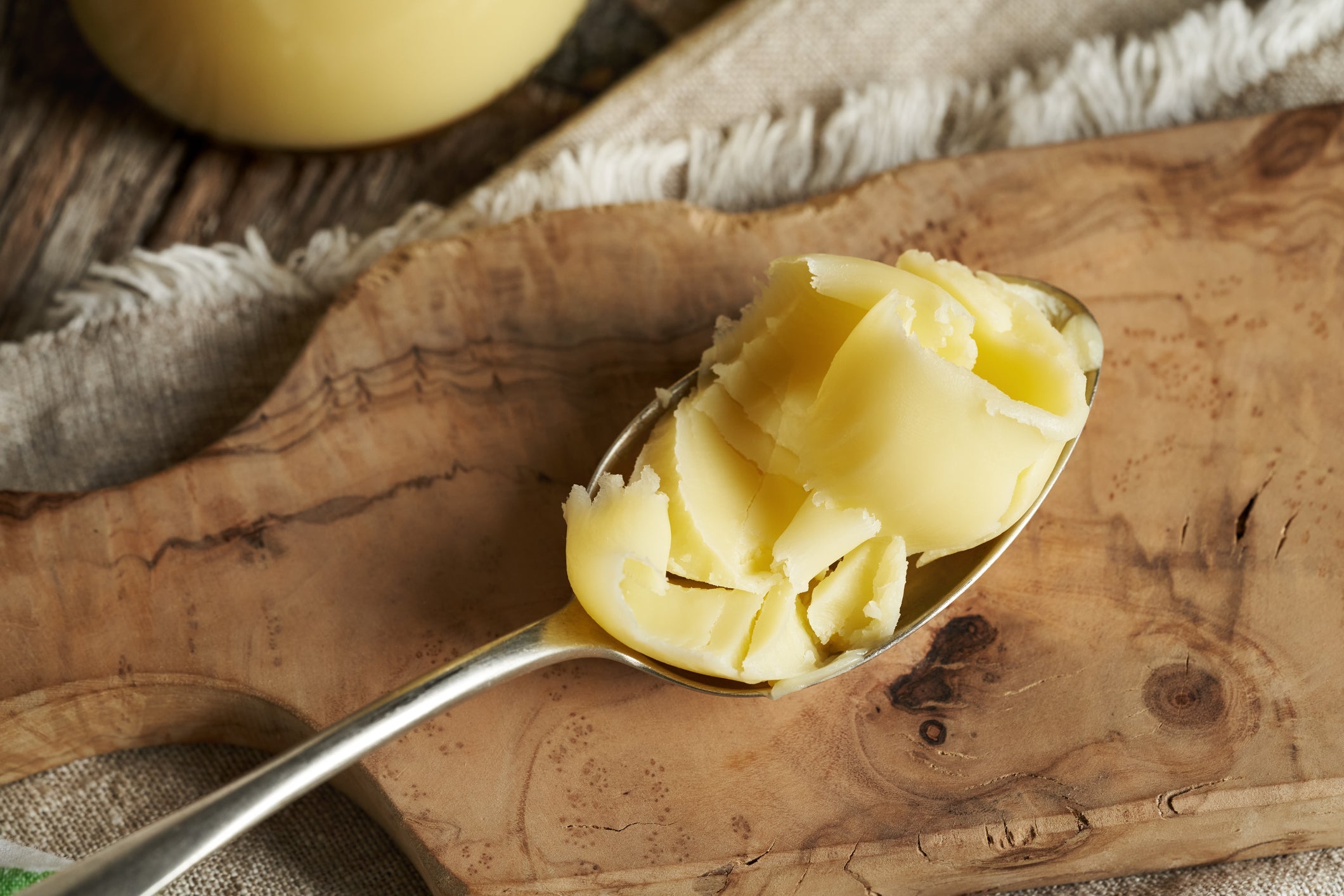
Ghee is clarified butter. Regular butter is melted slowly, the milk solids are skimmed off and the water is evaporated away, leaving behind pure butterfat. The result is a golden, nutty-flavored cooking fat that has been used in South Asian cooking for thousands of years, particularly in Indian cuisine. Like tallow, ghee from grass-fed cows has a richer nutritional profile than ghee from conventional dairy.
Because the milk solids are removed during clarification, ghee is essentially lactose-free and casein-free. This makes it tolerable for many people who cannot eat regular butter due to dairy sensitivities. It also makes ghee shelf-stable at room temperature for months, where regular butter would spoil quickly.
The Smoke Point Comparison
Smoke point matters because cooking a fat above its smoke point produces compounds that are inflammatory and undesirable. Tallow has a smoke point around 400 degrees Fahrenheit, which is high enough for almost any cooking application including frying, roasting, and searing. Ghee has an even higher smoke point, around 485 degrees Fahrenheit, making it the choice for the highest-heat cooking applications.
For practical home cooking, both are well within the range of any reasonable temperature you would use. The smoke point difference matters most for deep frying or very high-heat searing, where ghee has a slight edge. For sautéing, roasting, and general cooking, either works well.
Nutritional Profile Differences
Tallow and ghee share several nutritional features. Both are saturated-fat-rich, both provide fat-soluble vitamins (A, D, E, K), and both are stable enough to resist oxidation during cooking. The differences are in the specifics.
Tallow contains more conjugated linoleic acid (CLA), a fatty acid associated with some metabolic benefits in research. Tallow also contains stearic acid in higher amounts, a saturated fat that some research suggests behaves neutrally on cholesterol unlike other saturated fats. Tallow provides oleic acid (the same fat found abundantly in olive oil), which makes up roughly 40 to 50 percent of tallow’s fatty acid profile.
Ghee is higher in butyrate, a short-chain fatty acid that supports gut lining health and is the preferred fuel source for colon cells. Ghee provides vitamin K2 in usable amounts, which is increasingly recognized as important for cardiovascular and bone health. Ghee’s flavor profile (nutty, caramelized) is often preferred for the specific dishes it traditionally accompanies.
Flavor and Cooking Applications
Tallow has a clean, slightly beefy flavor that is most noticeable when used on its own and almost imperceptible when used as part of a more flavorful dish. It excels at roasting vegetables (giving them a deeply browned, restaurant-quality finish), searing meat, frying potatoes, and any application where you want a clean fat that does not compete with the flavor of the food.
Ghee has a nuttier, more pronounced flavor that lends itself to dishes where the fat itself contributes to the character of the food. It works beautifully in Indian curries, drizzled over rice, used in baking, or added to vegetables for a more aromatic finish. Many cooks find that ghee pairs particularly well with spices, which is why it dominates Indian cuisine.
Dairy Considerations
If you avoid dairy entirely, tallow is the clear choice. It contains no milk components whatsoever and is appropriate for anyone with severe dairy allergies. Ghee, while clarified to remove most milk solids, still contains trace amounts of dairy proteins. Many people with mild lactose intolerance tolerate ghee well, but those with more severe milk protein allergies should avoid it.
Tallow is also appropriate for strict carnivore or specific elimination diets that exclude dairy. Ghee fits in less restrictive frameworks where small dairy traces are acceptable. The bone broth diet structure outlined in the Bone Broth Diet framework tends to favor tallow over ghee specifically because of the cleaner dairy profile.
Cost and Availability
Both tallow and ghee have become more available as their popularity has grown. Quality grass-fed tallow is typically less expensive than quality grass-fed ghee, partly because tallow is a byproduct of beef production while ghee requires the additional clarification process. Either can be made at home from quality starting ingredients, though store-bought versions of both are now widely available.
If you cook frequently and want a sustainable everyday cooking fat, grass-fed tallow often delivers more value per dollar. If you cook less often and want a specialty fat with distinctive flavor, ghee is worth the higher price point.
Pairing Tallow With Bone Broth Cooking
Tallow particularly shines in dishes where it pairs with bone broth as a cooking medium. A roast vegetable sauté in tallow with bone broth used to deglaze the pan produces an extraordinarily flavorful base for any meal. The brand’s bone broth collection offers the slow-simmered grass-fed bone broth that makes this kind of cooking particularly rewarding.
Beef tallow also works beautifully alongside bone broth in soups and stews, where the rendered fat contributes both flavor and richness to the finished dish. Our companion post on beef tallow for skin covers tallow’s separate use as a skincare ingredient, which is becoming popular alongside its kitchen renaissance.
Choosing for Your Kitchen
If you want a simple framework, here it is. For everyday cooking where versatility and price matter most, choose grass-fed tallow. For specialty applications, traditional South Asian cooking, or when you want a distinctive nutty flavor, choose grass-fed ghee. Many cooks keep both on hand and use each where it shines. There is no need to choose one over the other if both fit your budget and your cooking style. The Tallow Cream we offer is built around the same high-quality grass-fed tallow that works well in the kitchen, though it is formulated specifically for skincare rather than cooking. For cooking, look for similarly grass-fed sourced products from a reputable supplier.
Frequently Asked Questions
Is Tallow Cream the same as cooking tallow?
Tallow Cream uses the same high-quality grass-fed tallow as the base ingredient, but the formulation is specifically prepared for skincare use rather than cooking. For cooking, look for rendered grass-fed beef tallow from a reputable food supplier. The underlying tallow has similar nutritional properties either way.
Can ghee replace tallow in skincare applications?
Ghee can be used as a skin moisturizer in some traditional applications, but Tallow Cream has a lipid profile that more closely matches human sebum, making it generally better suited for daily skincare use. Ghee tends to be heavier and more likely to feel greasy on the skin compared to properly formulated Tallow Cream.
Which has more calories, tallow or ghee?
Tallow and ghee have nearly identical calorie counts, both containing about 120 calories per tablespoon. They are pure fats, so the calorie content is essentially the same regardless of source. The differences between them are in the specific nutritional profile rather than the total calorie content.
Can Tallow Cream be eaten or only used on skin?
Tallow Cream is formulated as a skincare product, not a food product. For dietary tallow, use rendered beef tallow specifically sold for cooking from a reputable food supplier. Do not eat skincare-formulated tallow products, even if the underlying tallow ingredient is similar.
|
These statements have not been evaluated by the Food and Drug Administration. This product is not intended to diagnose, treat, cure, or prevent any disease. Results may vary by individual. Consult your healthcare provider before adding any new supplement to your routine. |