
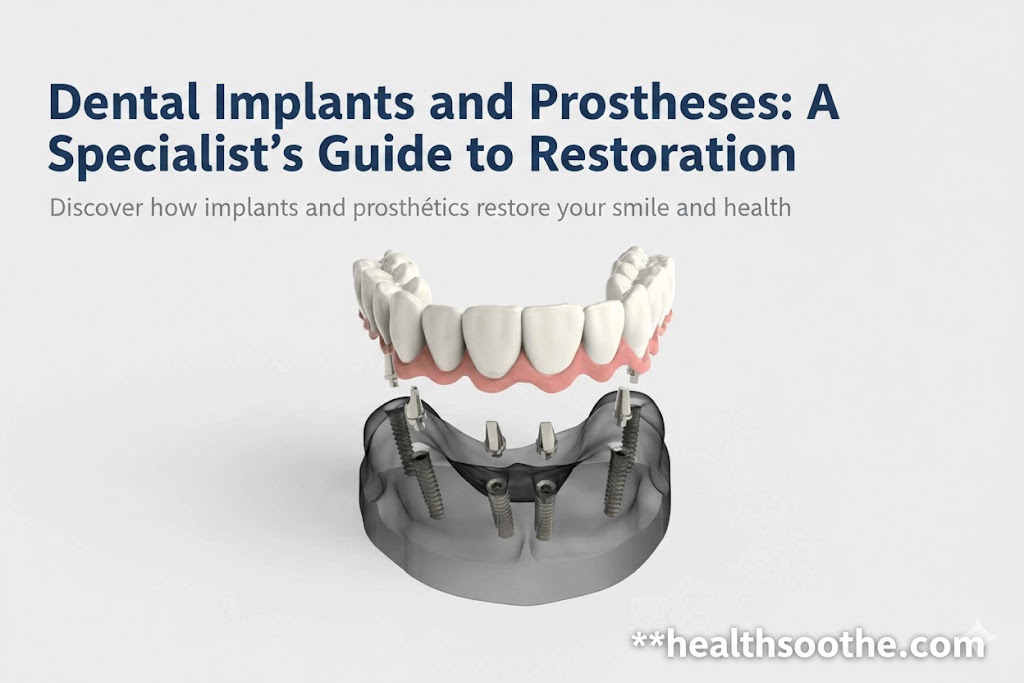
If you’ve spent any time in my chair, you know I don’t just see teeth—I see the foundation of your confidence and health. When a patient comes in with a missing tooth, the conversation almost always turns to dental implants. But there is often a bit of confusion about what an “implant” actually is versus the “prosthesis” that sits on top of it.
In my practice, I like to explain it this way: the implant is the new “root,” and the prosthesis is the new “tooth.” Understanding the synergy between these two is the secret to a smile that doesn’t just look good but actually lasts a lifetime.
The Anatomy of Restoration: Implants vs. Prostheses
From a clinical standpoint, a dental implant is a biocompatible titanium or zirconia fixture surgically placed into your jawbone. It relies on a biological process called osseointegration, where your bone literally grows around the implant to lock it in place.
However, the implant itself stays beneath the gum line. To restore your ability to chew and smile, we attach a dental prosthesis. This can range from a single crown to a full set of teeth. As recent market analysis shows, the demand for these procedures is surging—not just because we want to look younger, but because we finally have the technology to restore oral function to near-natural levels.
Choosing Your Solution: Types of Prostheses
No two mouths are the same, and as a specialist, my job is to analyze your bone density and lifestyle to pick the right “top” for your “roots.” There are five primary ways we approach this:
- Single Tooth Crowns: Perfect for a gap between healthy teeth.
- Implant-Supported Bridges: Ideal when several teeth in a row are missing, allowing us to bridge the gap without grinding down your natural teeth.
- Overdentures: These are removable but “snap” onto implants for far more stability than traditional dentures.
- Full-Arch Fixed (All-on-X): A permanent solution where an entire arch of teeth is supported by 4 to 6 strategically placed implants.
- Hybrid Prostheses: These offer the best of both worlds—permanently attached for the patient, but removable by the dentist for deep cleaning and maintenance.
Selecting the correct implant supported prosthesis is critical because it dictates how biting forces are distributed through your jaw. If the design is off, it can lead to material fatigue or even bone loss over time.
Why the “Analysis” Matters
I often tell my patients that dental implants are an investment in their facial structure. Without a tooth (or an implant) to stimulate the bone, the jaw starts to resorb or “melt away,” leading to that sunken-cheek look we often see with long-term denture wearers.
By choosing an implant-based restoration, you aren’t just filling a hole; you’re preserving your bone health. A well-placed implant can last 25 years or more, provided you maintain excellent oral hygiene and follow up with your dentist regularly.
The Bottom Line
Modern implantology has moved away from “one size fits all.” Whether we are looking at a single zirconia crown for a front tooth or a full-arch titanium-reinforced bridge, the goal remains the same: a stable, functional, and beautiful result.
If you’re considering this path, remember that the surgical placement of the implant is only half the battle. The magic happens when we design the prosthesis that brings your smile back to life.
Thank you for reading this post. Don’t forget to subscribe to our YouTube site here for Health and dental care content. Furthermore, follow us on Facebook, X.com (Twitter), Pinterest, Telegram, TikTok, LinkedIn, and WhatsApp Channel.